
Procurement your requisitioners actually use – supported by a team that stays
The procurement platform for indirect purchasing in corporate groups and large mid-sized companies
Software, implementation, operation and support by the developers – for a fixed annual price, alongside SAP and any ERP.
Ovenca is eProcurement software: Catalog Shop, Catalog Management, Vendor Portal and governance in one platform. It runs alongside SAP and other ERP systems, in a private cloud in Germany or in your own infrastructure.
LANXESS has worked with Onveda since 2014 and uses Ovenca worldwide.
One package: software, implementation, operation and support
All six building blocks come from Onveda. You pay a fixed annual price plus a one-off setup fee, with no transaction fees.
Software
Catalog Shop, Catalog Management with its Admin Area, and Vendor Portal in one platform. SAP contracts appear in search; if nothing fits, the need is captured as free text and matched against catalog suggestions.
Implementation
Go-live typically within 3–6 months. Onveda aligns ERP integration, user management, roles and catalogs with your departments.
Training and change
Training through the platform and in webinars, for requesters, procurement and administration.
Operation
Private cloud in Germany or your own infrastructure – in both cases Onveda deploys and maintains the application. Availability of 99.5% as a target.
Support by the developers
First response for P1 within 1 hour, for P2 within 4 hours. Service hours on working days 8:00–17:00 CET, on-call support for P1 available.
Further development
Ovenca is developed further on a regular basis, and this is included in the annual price. Individual feature requests that do not become part of the standard are charged separately.
The path to go-live
Six steps, typically 3–6 months. The alignment in steps 2 to 5 runs in parallel, not one after the other.
Introduction and product demo
Starting point, system landscape and scope. Ovenca shown with your use cases.
Align ERP integration
Contracts, material numbers and master data from the ERP, handover of orders.
Align user management
Sign-in via single sign-on with SAML 2.0 or OpenID Connect.
Align roles and permissions
Who orders, approves and maintains catalogs, per company and site.
Take over catalog data
Import via CSV, Excel or BMEcat, punchout via OCI or cXML.
Test and switchover
Testing with your data, then switchover on a cut-off date or area by area.
You talk to the people who write the code
Development, operation and support sit with the same team. The core team has been on board since 2014/2015.
- Jens Bohl
- Founder and managing director
- Sophie Raps
- Concept, design and development for Ovenca
- Pierre
- Product owner for Ovenca
LANXESS: working together since 2014
The speciality chemicals group uses Ovenca worldwide for catalog-based purchasing, with SAP contracts and material numbers directly in product search.
“By integrating SAP contracts and material numbers into product search, we were able to increase the automation of our purchase-to-pay processes as intended. On the clearly structured administration level we control the release and availability of content, manage user permissions and obtain the transparency we want through meaningful reports.”
- Company
- LANXESS AG, Cologne, speciality chemicals, MDAX
- Size
- approx. 11,800 employees in 32 countries
- Use
- worldwide, around 45 companies in 6 regions; first rollout 2015, renewed rollout 2026
- Integration
- SAP contracts and material numbers in search
The three modules in the product
Catalog Shop for requesters, Catalog Management for procurement, with the Admin Area for roles and approvals, and Vendor Portal for suppliers. The views show the product with demo data.
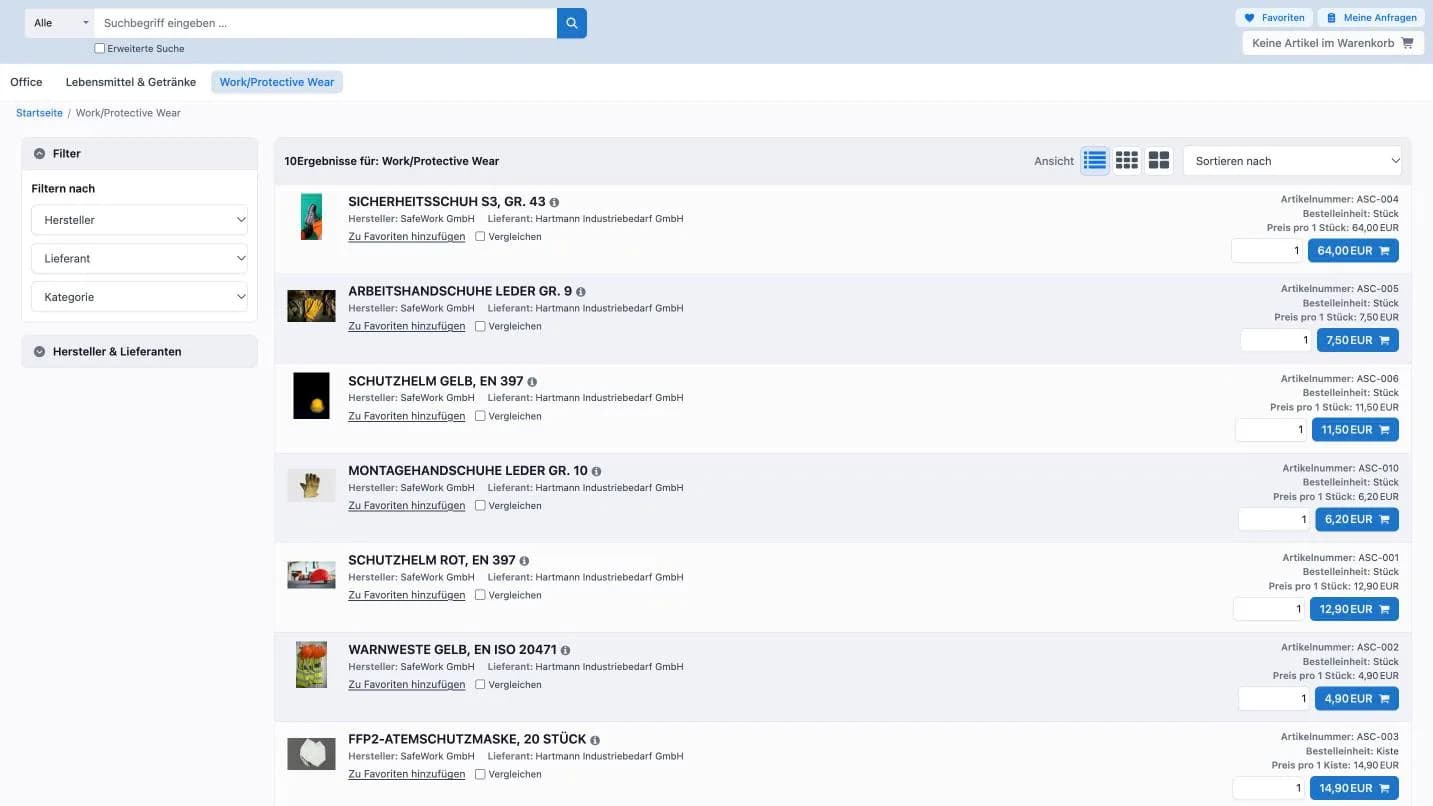


Search, compare, order. Free-text orders with catalog suggestions.View Catalog Shop
Product view with demo data. Enlarge view
- One search across all catalogsRequesters find items from internal catalogs and connected supplier catalogs in one place.
- Filters by manufacturer, supplier and categoryThe result list can be narrowed down without requesters having to know the individual catalogs.
- Price and order unit in every rowItem number, order unit and price appear right next to the item. One click puts it in the cart.
Simple for users, controlled for procurement
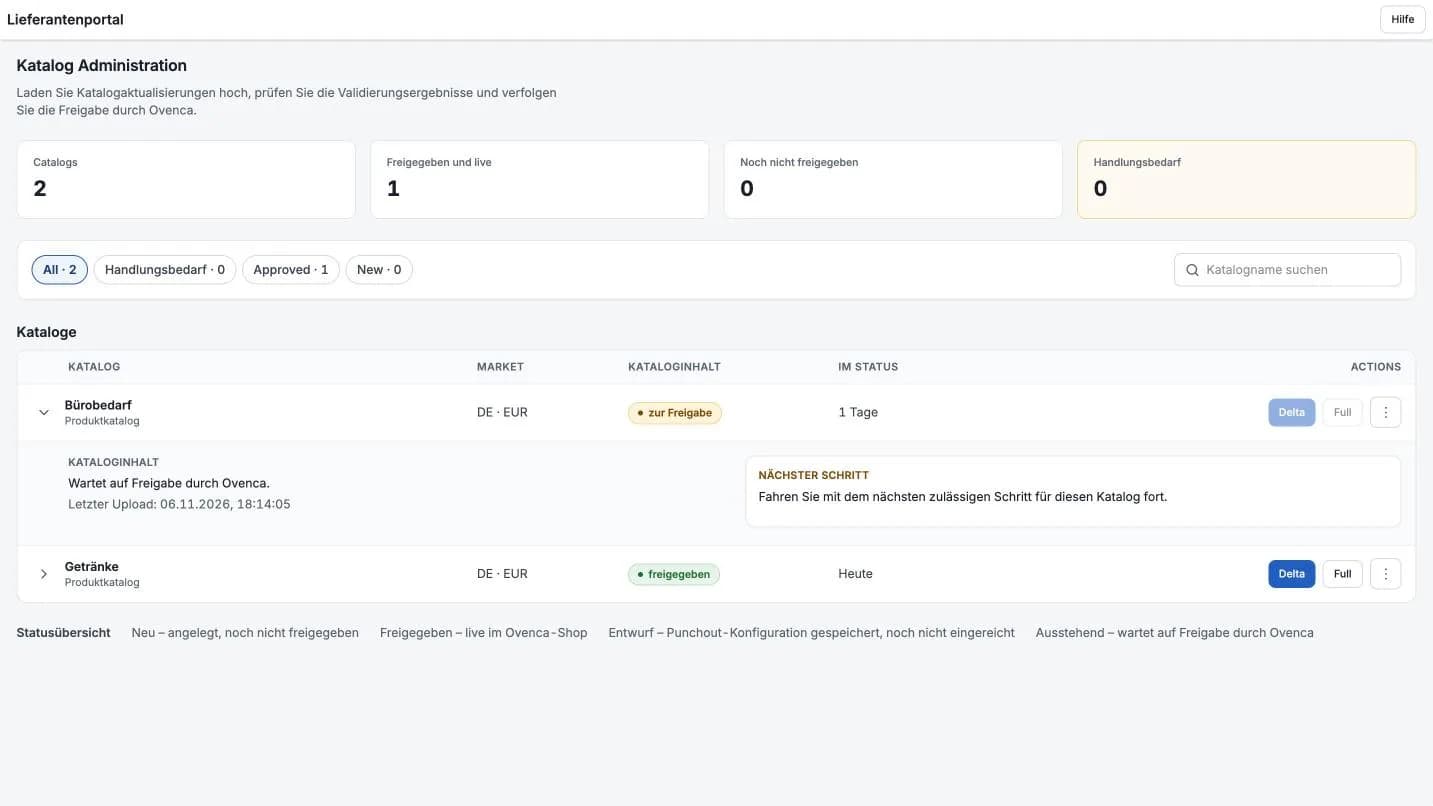
All views are taken from the product and show demo data.
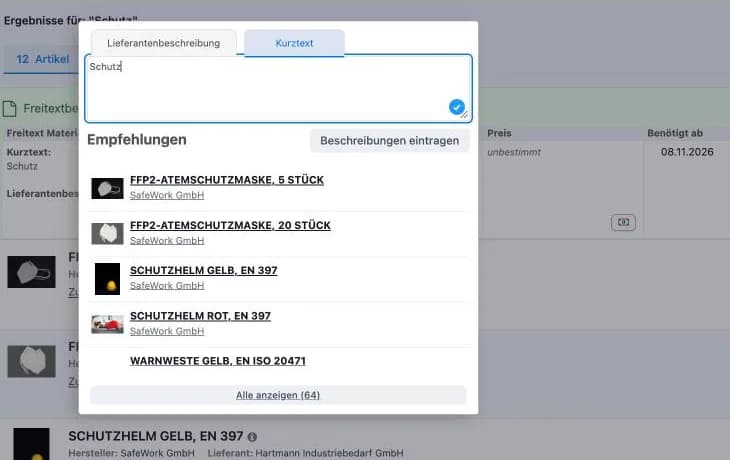
Free text becomes a qualified order
Anyone who finds nothing suitable describes the need. Ovenca suggests catalog items before a free-text order reaches procurement.

Permissions per role, object and relation
Read, create, update and delete are granted per role and individually for vendors, catalogs, products, legal entities and plants.

Configure punchout catalogs instead of coding them
Protocol, call URL, parameters and field mapping of a supplier catalog are maintained and tested in Catalog Management.
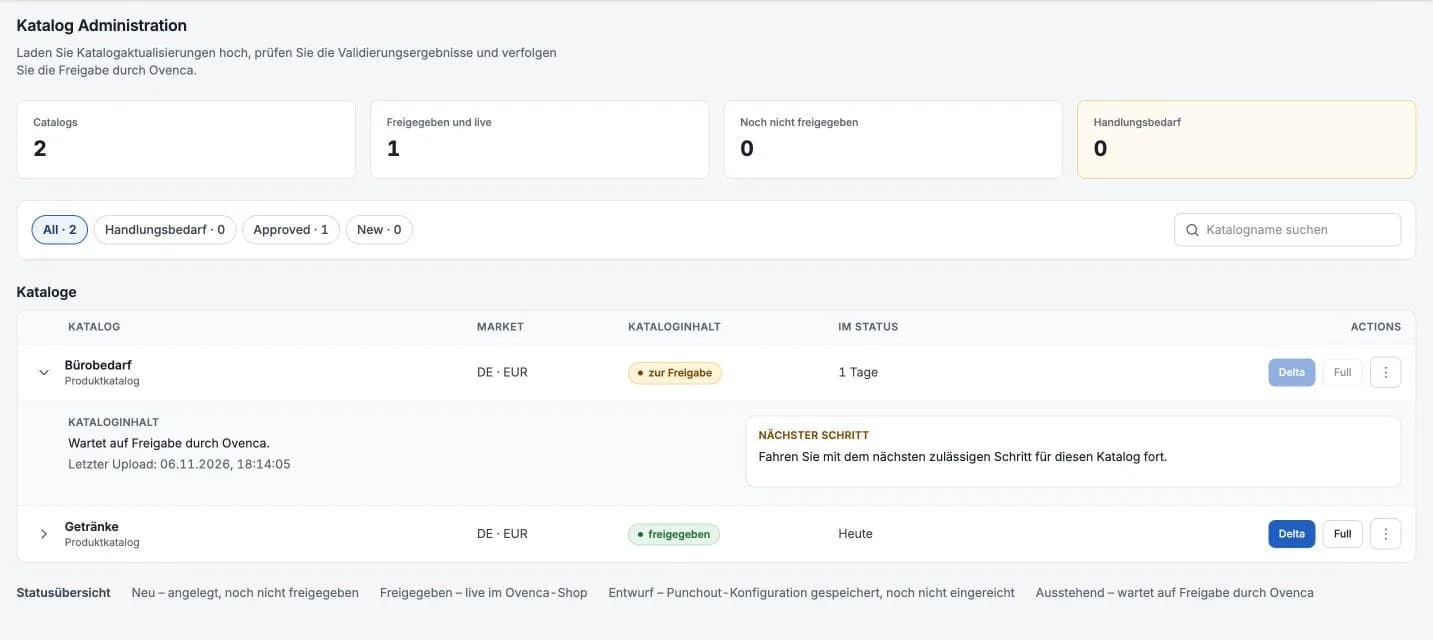
Suppliers deliver, procurement approves
Suppliers upload catalogs and correct errors themselves. Every catalog has a status, plus the last upload and the next step.
- Reference
- LANXESS, worldwide, working together since 2014
- Catalog volume
- more than 5 million items
- ERP systems
- SAP, Microsoft Dynamics NAV · others on request
- Operation
- Private cloud in Germany or your own infrastructure
- Interfaces
- OCI punchout, cXML, API
Security and operations
- SSO with SAML 2.0 and OIDC
- MFA (TOTP)
- Roles, permissions and audit trail
- DPA under the GDPR
- Private cloud in Germany or your own infrastructure
- 99.5% availability (target)
One platform alongside your ERP
Ovenca handles catalogs, purchase requisitions, approvals and supplier maintenance. Purchase orders, contracts and master data stay with the ERP as the system of record. The three modules can be introduced individually and extended later. The platform is designed so that procurement has little to do with it in day-to-day business: suppliers maintain and correct their catalogs themselves, requesters find items through search.
User groups
OvencaOperated by Onveda: private cloud in Germany or your own infrastructure
- Requesters in the business units
Catalog Shop
Search, compare, order. Free-text orders with catalog suggestions.
- Procurement
Catalog Management
Import, validate and approve catalogs. Configure SmartForms and punchout catalogs.
- Suppliers
Vendor Portal
Maintain catalogs themselves, correct errors after validation, submit for approval.
- Administration
Admin Area in Catalog Management
Roles and permissions, legal entities and plants, visibility, reporting.
Integration layer
- OCI punchout
- cXML
- API
- CSV, Excel and BMEcat import
- SSO with SAML 2.0 and OIDC
- Purchase requisitions and orders
- Contracts, material numbers, master data
ERP systems
SAP (ECC, S/4HANA), Microsoft Dynamics NAV, further ERP via OCI, cXML, API
- Purchase requisitions and orders
- Contracts, material numbers, master data
- Call with user context
- Shopping cart via OCI or cXML
External supplier catalogs
Punchout into the supplier's shop
- Call with user context
- Shopping cart via OCI or cXML
Operation and security
You decide where Ovenca runs – in both cases Onveda operates the application – – in both cases Onveda operates the application – and where your procurement and supplier data resides.
| Criterion | Your infrastructure (e.g. Azure) | Private cloud |
|---|---|---|
| Location of the instance | Your data centre or your own cloud environment | Separate instance in a data centre in Germany |
| Operation | Onveda deploys and maintains the application in your environment | Onveda operates the instance for you |
| Data residency | Entirely within your infrastructure | In Germany |
| Data protection | Data stays in your infrastructure; data processing agreement under Art. 28 GDPR for operation and maintenance by Onveda | Data processing agreement under Art. 28 GDPR |
In both models Onveda handles maintenance, updates and support.
Access and traceability
- Roles and permissions
- Permissions per role, legal entity and plant
- Audit trail
- Changes to catalogs, approvals and users are logged
- Single sign-on
- SAML 2.0 and OpenID Connect
- Multi-factor authentication
- TOTP via authenticator app
- Transport encryption
- TLS for the web interface and interfaces
Typical starting points
Ovenca is rarely introduced on a greenfield site. There is usually a leading ERP, a legacy system and a specific trigger.
SAP SRM is being phased out
Mainstream maintenance for SAP SRM 7.0 ends on 31 December 2027. Ovenca replaces catalog, requisition and approval and stays connected to SAP.
SAP Ariba is under review
Operation under your own control instead of a multi-tenant cloud, no network fees for suppliers. Including an assessment of when Ariba remains the better choice.
S/4HANA transformation
Operational procurement needs an interface for requesters that does not depend on the ERP release cycle.
Indirect procurement is fragmented
Several legal entities, plants and ERP instances, plus catalogs in Excel and email. Ovenca brings demand, catalogs and approvals together.
German Supply Chain Act
Supplier onboarding with questionnaires, self-disclosures and evidence in the Vendor Portal.
When Ovenca fits and when it does not
Ovenca fits if you
- want to manage indirect procurement through catalogs, approvals and a supplier portal
- run several ERP systems or SAP instances in parallel
- want to decide on operating location and data residency yourself
- want to introduce modules one at a time rather than a full suite
A suite fits better if you
- need global, network-based tendering through a supplier network
- want to source all procurement functions from your ERP vendor
Material for your evaluation
Calculator
ROI calculator
Savings potential based on your own figures. The assumptions are stated openly.
Overview
Cost logic
What licence, implementation and operation depend on.
Whitepaper
From SAP Ariba to an ERP-independent procurement platform
Decision framework, migration paths and a template for the cost calculation. PDF, 10 pages, in German.
Case study
LANXESS: eProcurement in speciality chemicals
Starting point, solution, operation and the return from SAP Ariba.
Guide
Source-to-pay: process and platform
Phases, how it differs from P2P and S2C, selection criteria.
Guide
Benefits of digital procurement
What digital processes actually change in procurement.
Glossary
OCI, punchout, cXML and other terms
Terms from eProcurement and the SAP environment, briefly explained.
Questions about the Ovenca procurement platform
A procurement platform, also called an eProcurement platform, brings a company's ordering processes together in one system: catalogs, orders, approvals, and the connection to suppliers and the ERP. Ovenca is a digital procurement platform for indirect procurement and consists of a catalog shop, catalog management with an admin area, and a vendor portal.
Ovenca is built for larger mid-market companies and corporations in the DACH region that manage indirect procurement across many sites, roles and suppliers. Several legal entities, plants and ERP instances are typical. Catalog Shop, Catalog Management with its Admin Area, and Vendor Portal can be introduced individually or together.
Ovenca runs as a separate instance in a private cloud in a data centre in Germany or in your own infrastructure, for example your Azure environment. In both cases Onveda deploys and maintains the application. You decide where your procurement and supplier data is stored.
Ovenca is not tied to one ERP. SAP and Microsoft Dynamics NAV (Navision) are connected; Onveda connects further ERP systems individually during setup – via OCI, cXML or API. The platform runs alongside the ERP and does not replace it. Integration is done through open interfaces; supplier catalogs are connected via punchout (OCI).
Typically 3–6 months until go-live. The path has six steps: product demo, ERP integration, user management, roles and permissions, catalog data, and testing and switchover. The alignment runs in parallel, not one after the other.
The fixed annual price covers software, operation, support by the developers and regular further development. Setup is charged once. There are no transaction fees, and suppliers pay nothing. Individual feature requests that do not become part of the standard are charged separately.
How an evaluation starts
Discussion of your starting point
System landscape, legacy system, trigger and scope. Afterwards you know whether Ovenca fits your situation.
Product demo based on your scenarios
Catalog, approvals, supplier portal and administration, shown using your use cases.
Integration and operating concept
Interfaces to the ERP, operating model and roles. This results in your cost framework.